
Three ways to control the lights in your home
They look almost the same on the wall. Behind it they are completely different, and the difference shows up on the electrician's bill as much as on the lighting quote.
It comes down to where the dimming happens
Every lighting system does the same job. Power leaves the electrical panel, travels to a light, and somewhere along the way something decides how bright that light will be.
The three systems below put that decision in three places: the switch on your wall, a cabinet in a closet, or the light itself. That choice sets how much wire has to be pulled through the house and what you can change once the walls are closed up.
System one
Traditional switches and dimmers
Most houses have this. The lights are divided into groups, and each group gets its own wire run from the electrical panel to a switch by the door, then out to the lights. The dimmer on the wall is the entire control system.
One switch, one group. Four groups of light in the kitchen means four switches by the door and four separate wire runs back to the panel.
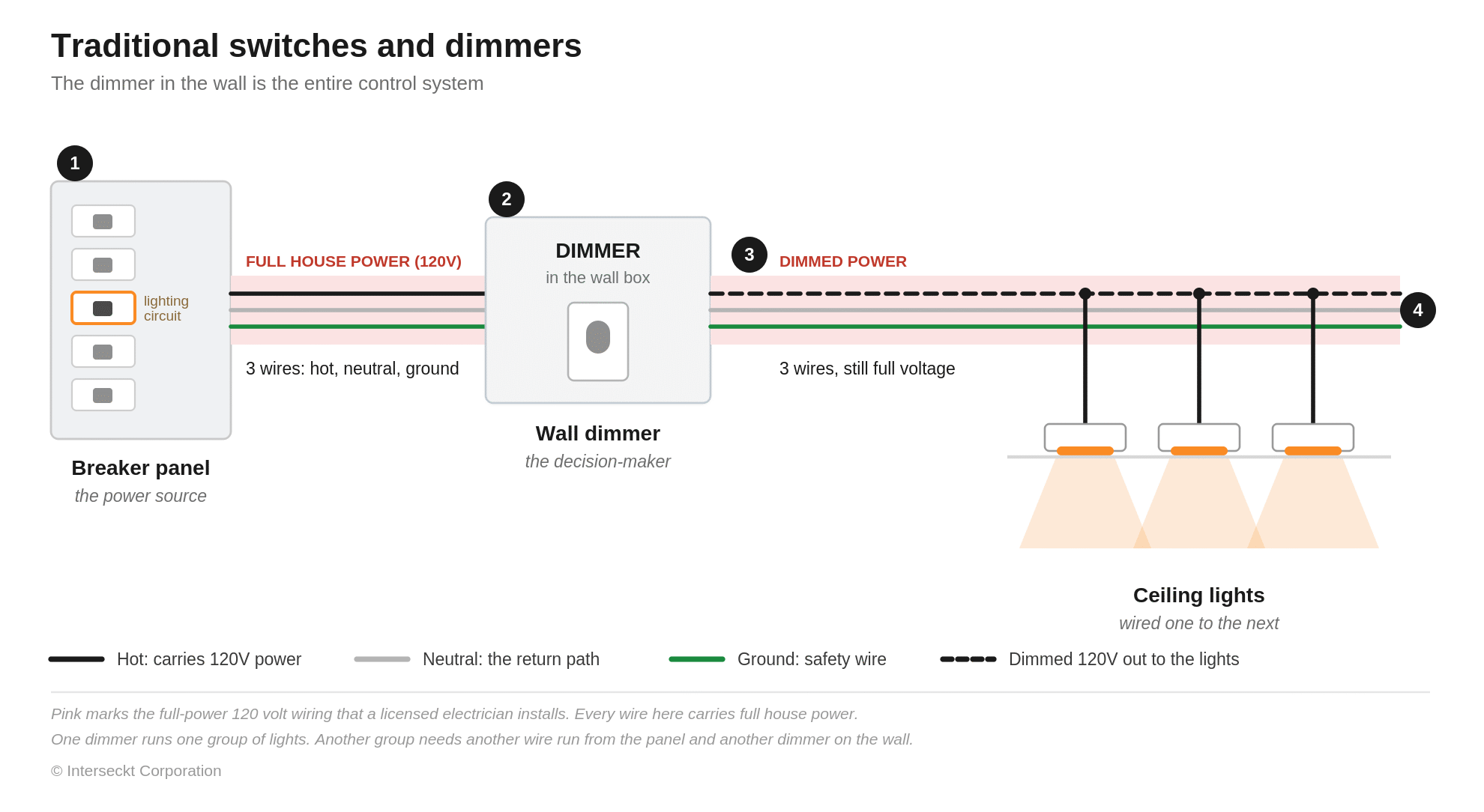
Every wire here carries full house power. The dimmer on the wall is the whole control system.
Three wires come from the breaker panel. Hot carries the power, neutral brings it back, and ground is the safety wire.
The dimmer is the control system. It sits in the wall by the door, and turning it down cuts the power heading out to the lights.
Three wires leave the dimmer and carry the dimmed power out to the ceiling. All of it is still at full house voltage.
The lights are wired one to the next. Another group of lights needs another wire run from the panel and another dimmer on the wall.
What it does well
- The cheapest equipment of the three, by a wide margin.
- Any licensed electrician can install it and repair it.
- Nothing to program or set up.
Where it runs out
- Rooms end up with five or six switches by the door, and nobody remembers which is which.
- There is no way to set a whole room at once.
- Changing which lights turn on together means opening walls.
System two
Panel based lighting control
Here the dimmers come off the wall and move into a closet. They sit stacked in metal cabinets, and a separate wire run goes from each dimmer out to the group of lights it controls.
What replaces the switch is a keypad, a small plate of labeled buttons. No lighting power runs through it, only a thin wire back to the closet. One button can set a whole room at once. You can also run the lights from an app on your phone, or by voice, and what a button does can be changed later without rewiring. The catch is wire. Each group of lights still needs its own run, and a large house can need well over a hundred.
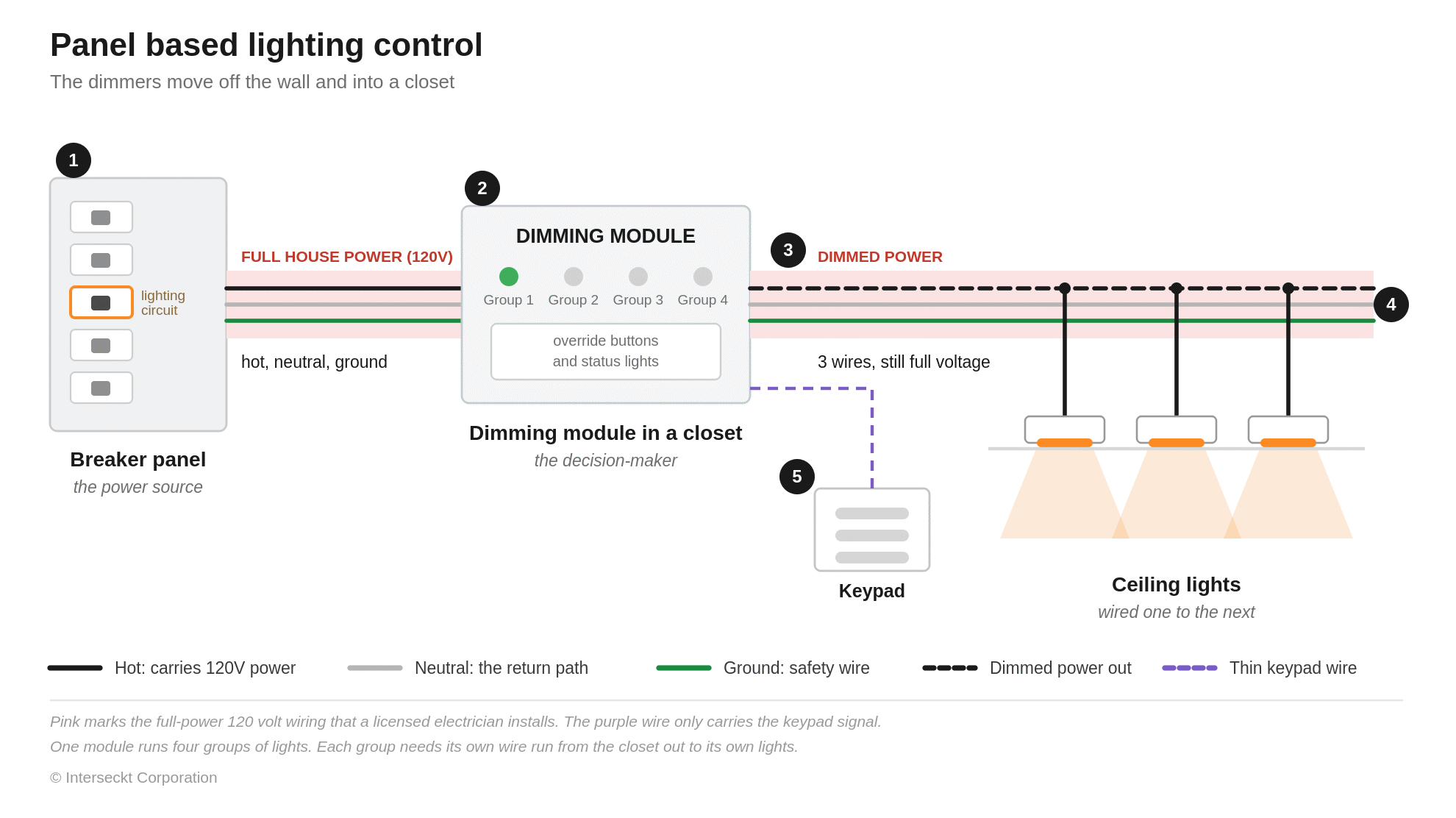
The dimmers moved to a closet, but the amount of wire did not change.
Three wires come from the breaker panel. Hot, neutral and ground, the same as any light in the house.
The dimmers in the closet do the work. Pressing a keypad button tells them to turn the lights on and set the brightness.
Three wires leave the closet and carry the dimmed power out to the ceiling.
The keypad carries no lighting power. Only a thin wire runs from it back to the closet. Each group of lights still needs its own run from the closet out to the ceiling.
What it does well
- One keypad replaces a wall of switches.
- One button can set an entire room, or the whole house.
- It dims almost any light, so you can buy whatever fixtures you like.
Where it runs out
- It uses just as much wire as a traditional system, so the electrician's cost stays high.
- The cabinets take up real closet space.
- Which lights turn on together is decided by the wiring.
System three
Smart light fixtures
The third approach puts the controls inside the light. Every light has its own address on the system, the way every phone in your house has its own address on the wifi.
Power runs to the ceiling on a few shared wires and stays on. The system tells the lights apart by address rather than by wiring, so two lights on the same wire can sit at different brightness levels. Many also offer tunable white, meaning the light can shift from warm to cool through the day, and some offer full color. Which lights turn on together is no longer decided by the wiring, so it can be changed without opening a wall.
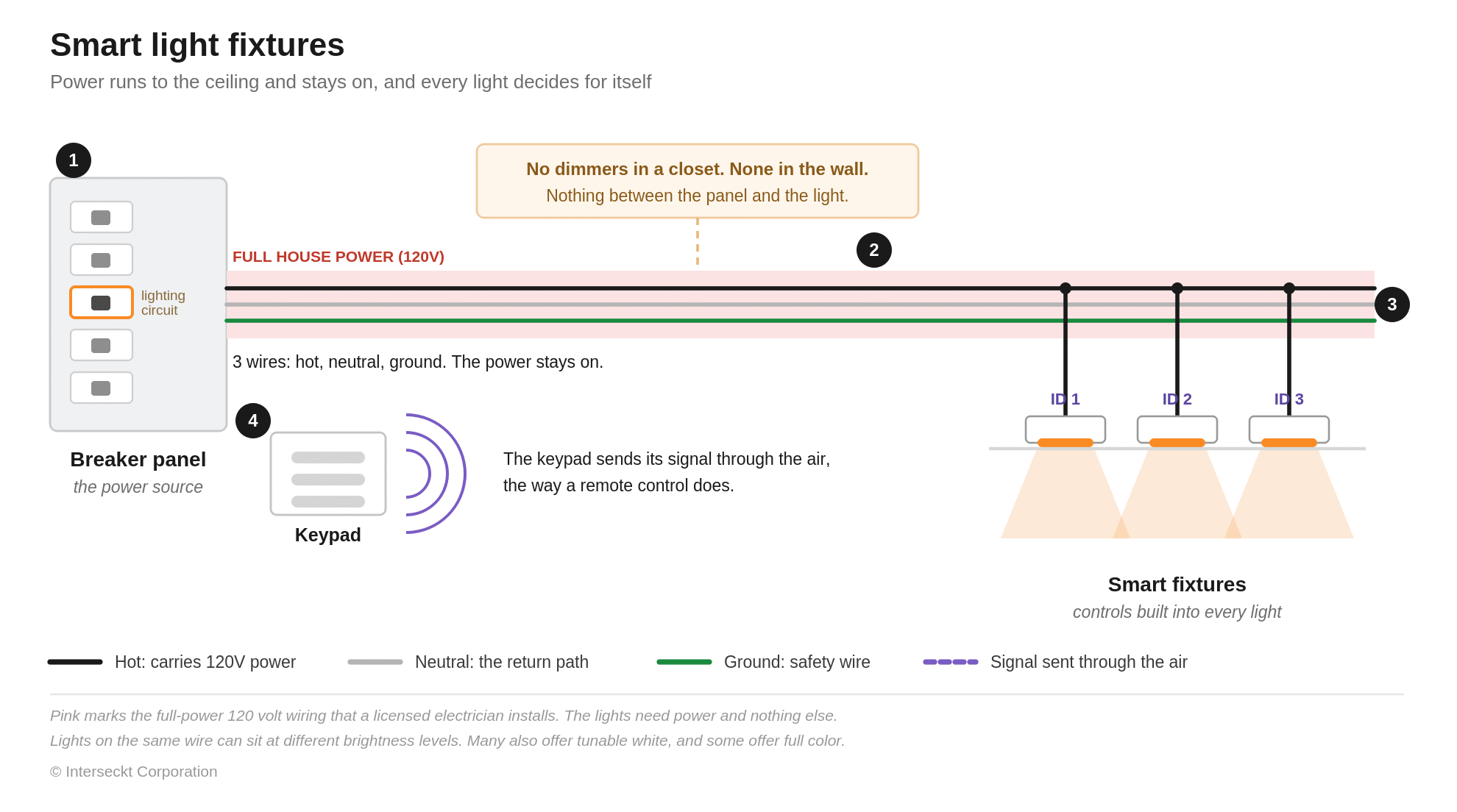
No dimmers in a closet and none in the wall. The lights need power and nothing else.
Three wires come from the breaker panel. Hot, neutral and ground, the same as any light in the house.
Nothing sits in between. No dimmers in a closet and none in the wall, so the power runs to the ceiling and stays on.
The lights share that one wire. Each one has its controls and its own address built in, and it sets its own brightness.
The keypad sends its signal through the air, the way a remote control does. Two lights on the same wire can do different things.
What it does well
- Far less wire to pull, which is where the savings on the installation come from.
- Little or no closet space given up to equipment.
- Any light can be reassigned to a different button without opening a wall.
Where it runs out
- The lights themselves are the most expensive of the three.
- They have to come from the company that makes the control system, so there are fewer looks to choose from.
- It has to be decided before the electrician prices the job.
Side by side
The same house, wired three ways.
| Traditional switches | Panel based control | Smart fixtures | |
|---|---|---|---|
| Where the dimming happens | In the switch on the wall | In a cabinet in a closet | Inside the light |
| Wire runs out to the lights | One per group | One per group | A few shared runs |
| Closet space needed | None | Several cabinets | One small box, sometimes none |
| Changing which lights go together | Open the wall | Open the wall | Changed without opening a wall |
| Tunable white and color | No | Depends on the lights you buy | Yes, on lights that offer it |
| Cost of the equipment | Lowest | Middle | Highest |
| Cost of the electrical work | Highest | Highest | Lowest |
The part nobody explains
Why the priciest system is not the priciest to install
The lighting quote is one number. The electrician's number is the other one, and it moves the other way.
Electricians price the job largely by the wire. Every run has to be pulled from the panel through the framing, connected at both ends and tested. Fewer runs means fewer hours and fewer days on site.
Here is one real comparison, a two-story home of roughly 10,000 square feet priced two ways.
So what happened to the total
The lights cost close to double. The control equipment went the other way and fell by roughly half, because the dimming had moved into the lights. Those two swings nearly cancelled, and the parts bill for both systems landed within a fraction of a percent. The labor broke the tie. The smart fixture system finished about 12 percent below the traditional one once everything was bought and installed.
Your house will not produce these exact numbers. The direction carries over. Lights up, wire and labor sharply down, and a total far closer to a traditional system than the lighting quote alone would suggest.
Two things to know before you decide
The savings only exist if you decide early. The electrician prices the job from drawings that say how many wire runs to pull. Decide before that price is set and the smaller number is built in. Decide after the wire is in the walls and you pay for both.
The three approaches also mix. Most of the houses we finish use more than one, and there is no prize for running everything the same way.
Traditional
Garages, closets, small remodels, and any room where you will never want to set the whole room with one button.
Panel based
The usual choice for a whole house with keypads. It dims almost any light, so you can buy whatever fixtures you like.
Smart fixtures
New construction and major remodels, especially where the ceilings are full of recessed lights.
Tell us about the house
Interseckt designs and installs lighting control for homes, with a focus on South Florida and the Caribbean. We work with Lutron, Crestron, Control4, Savant and other manufacturers, and we are not tied to any one of them.
Send us the plans, or just describe the project. If the electrician has not priced the job yet, this is the right moment to talk.